

All customers
Industry
Smart Manufacturing
Use Case
Fleet health monitoring, real-time dashboards, self-service analytics
Impact
Cost-effective scaling, 3x compression, high reliability
Powered by Tiger Cloud on AWS
Fully-managed cloud Postgres platform from Tiger Data running on AWS with S3 tiered data storage
“Cost wise, it's very good for us. The Tiger Cloud solution is very cost effective. We've been getting a very decent benefit in performance. We just quantified what our cost per sensor is out there, and it's good and we're happy with the results.”
Carlos Almos, Senior Principal Software Engineer, Everactive
How Everactive Monitors Battery-Free Industrial IoT Sensors at Scale with Tiger Data on AWS
A manufacturing IoT company consolidated terabytes of sensor telemetry into Tiger Cloud, giving 300+ manufacturing partners self-serve access to fleet health analytics.
Everactive manufactures ultra-low-power, batteryless wireless sensors for industrial facilities. When manufacturing partners deploy thousands of these sensors across production floors and supply chains, the operational burden of monitoring fleet health and detecting connection anomalies falls on Everactive's support and engineering teams. The company's cloud platform was ingesting over a terabyte of time-series sensor data. To serve 300+ manufacturing partners profitably, they needed a database where per-sensor operational costs stayed manageable and competitive. Everactive moved all sensor data to Tiger Cloud on AWS and gained a cost-effective, reliable system that now serves as the central operational database for their entire business. This case study explores how Everactive's architecture team evaluated the move, why they chose Tiger Cloud over self-hosted alternatives, and how the benefits compounded as their customer base scaled.
About Everactive
Manufacturing operations depend on the visibility that only dense sensor networks provide. Yet today's wireless sensors require frequent battery replacement. In automotive plants, battery changes mean production line stoppages. In renewable energy installations, climbing towers to swap batteries exposes technicians to risk and cost. In supply chain tracking, unplanned downtime due to dead batteries cascades upstream.
Everactive solves this by building energy-harvesting sensors that draw power from vibration, thermal gradients, and ambient radio signals. No battery replacement cycles means no production disruption and dramatically lower ownership cost per sensor over a facility's lifetime. The company operates as a platform, not a device vendor. Customers integrate Everactive sensors into their factory networks, and Everactive runs a cloud platform that collects, processes, and exposes the telemetry so customers can build their own fleet health dashboards, anomaly detectors, and predictive maintenance workflows.
That platform had to handle several hard requirements at once. First, sensor data arrives relentlessly: thousands of devices reporting measurements every few seconds, creating millions of data points per day per facility. Second, multiple stakeholder teams need access. Operations teams need real-time dashboards. Support engineers need to investigate sensor connectivity. Sales engineers need to show health metrics to prospective customers. Analytics teams need to build ML models. Third, cost per sensor is the business model. Every dollar of infrastructure cost per deployed device erodes margin. As the customer base scaled from dozens to hundreds of facilities, keeping infrastructure cost-effective wasn't negotiable.
The Challenge
For years, Everactive's data platform was fragmented. Time-series data arrived via Kafka from millions of sensors globally, then got ingested into multiple databases and data stores. Operational dashboards ran off one copy. Analytics workloads ran off another. Keeping these systems in sync required custom ETL. Every new operational need meant building another pipeline. The result: growing complexity, rising query latency, and weeks of work just to support a new use case from operations or sales.
The fundamental problem was architectural. Different teams used different systems because no single database handled time-series ingestion, real-time query performance, and analytical queries equally well. Data scattered across systems meant no single source of truth.
At a certain point this became unsustainable. Everactive's customer list was growing. Data volumes were multiplying. Each new customer deployment meant more sensors, more data, more pressure on sprawling infrastructure. The engineering team knew the business model wouldn't survive without consolidating the data layer.
The Architectural Decision: Why Tiger Cloud on AWS
Everactive's architects looked at several options. Self-hosted Postgres would be cheap but would burden the operations team with upgrade management, backup orchestration, and scaling decisions. Cloud-managed offerings either specialized in time-series (InfluxDB, Prometheus) but lacked the SQL flexibility for operational analytics, or specialized in OLAP (Redshift, BigQuery) but weren't designed for high-frequency sensor ingestion.
Then Principal Architect Carlos Olmos and the engineering team evaluated TimescaleDB. TimescaleDB is Postgres extended for time-series: hypertables automatically partition incoming measurements by time and space (sensor ID); columnar compression reduces storage footprint without sacrificing query speed; and the full power of SQL is available for operational analytics. Crucially, TimescaleDB runs on managed AWS infrastructure via Tiger Cloud, so Everactive wouldn't have to manage the database itself.
The decision came down to what they actually needed: (a) one system of record that every team could query directly in SQL without middleware; (b) high-frequency time-series ingestion performance; (c) cost-effective storage and compute that scaled with customer count; and (d) compliance-ready infrastructure for their enterprise customers. Self-hosted deployment would have taken months of migration and operational work, and they already had SOC 2 compliance requirements that a managed service met more easily than on-prem.
The Tiger Data Stack
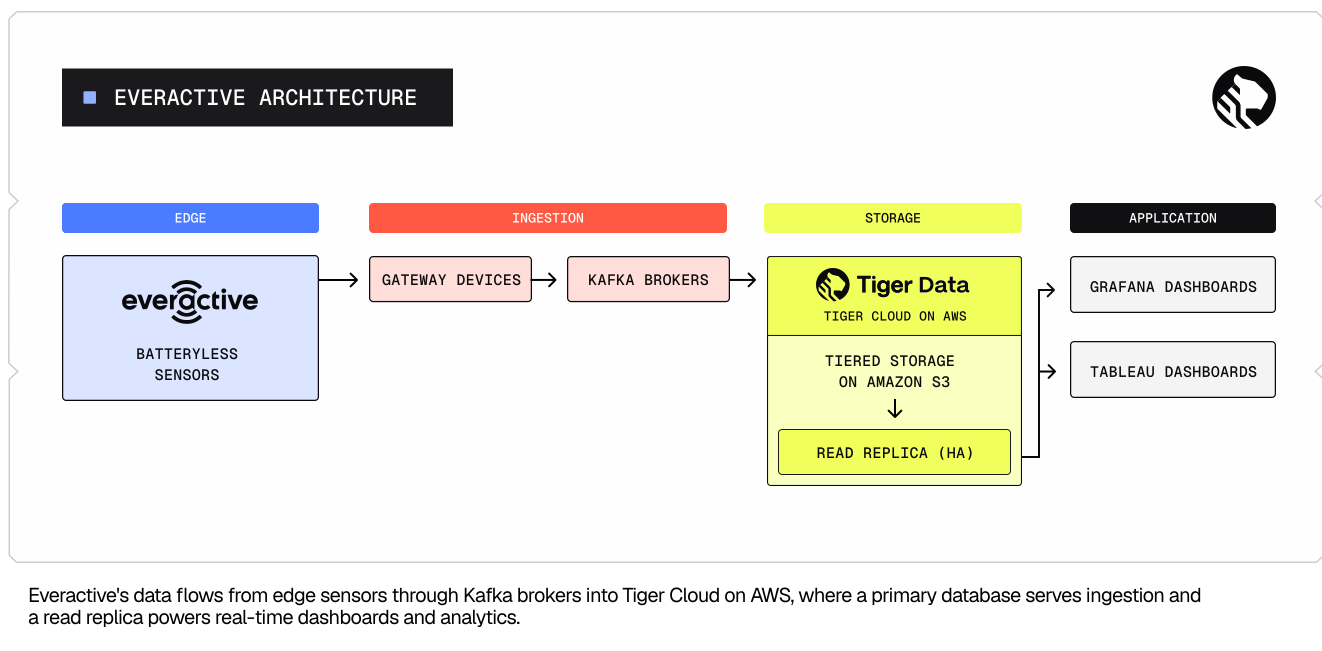
Everactive's data pipeline flows from edge to analytics in layers. Battery-free sensors deployed across customer facilities capture vibration, temperature, and RF energy readings and transmit them wirelessly to industrial Linux gateway devices stationed at each facility. Gateways forward the time-series data to Kafka brokers that Everactive operates in AWS, which acts as a decoupling layer and buffer.
From there, an ingestion layer reads messages, validates device identity and measurement ranges, applies customer-specific calibration thresholds, and writes the normalized data into Tiger Cloud. The database stores these measurements in hypertables with compression enabled, so storage footprint shrinks while query performance stays fast and costs stay low.
High availability is built in. A primary database instance handles all write traffic from ingestion. A read replica in a separate AWS availability zone serves all operational analytics queries. Grafana dashboards connect to the read replica for real-time fleet health visualization. Tableau dashboards do the same for sales engineers and operations teams. A staging environment mirrors production schema and recent data, so teams can test new queries before running them against live data.
Backups run through Tiger Data's native point-in-time recovery (30-day retention) plus a custom process that writes daily snapshots to Amazon S3 for longer-term archival. For enterprise customers who need on-prem data sovereignty, Everactive also runs a second TimescaleDB deployment on customer infrastructure, synchronized via periodic API exports.
Results: From Fragmented Stack to Single System of Record
Cost efficiency across customer fleet: Everactive explicitly tracks cost per sensor, the core business metric. With Tiger Cloud, that number immediately improved and they consequently achieved cost-effective operations at scale. The company's cost per sensor now reflects the consolidated stack advantage: no data duplication, no redundant pipeline engineering, no sprawl. When sales engineers pitch Everactive to new manufacturing customers, they can quote a margin-healthy cost per installation.
Compression Exceeded Expectations: When Everactive's team first deployed Tiger Cloud, they achieved a 3x compression ratio compared to their baseline uncompressed Postgres. As they enabled columnar compression and optimized their chunk sizing, they exceeded those initial expectations.
Self-service analytics adoption: One of the biggest wins was operational. With the old fragmented stack, only the analytics team could access data. Now, with a single SQL database available to all teams and Grafana dashboards hooked directly to the read replica, any team can ask ad-hoc questions about sensor connectivity, fleet health, and customer deployments.
"Other teams have been able to quickly make use of Tiger Cloud due to the familiar SQL syntax. Just about any team who needs to get information about the various sensors have been able to do so on their own." –Owen Zanzal, Principal Software Engineer, Everactive
Organic dashboard ecosystem: Once Grafana was connected to the read replica, adoption accelerated organically. Teams started building dashboards without waiting for the analytics team to custom-develop solutions. The facility operations team built a facility overview dashboard. The network ops team built connectivity tracking dashboards. The sales team built demo dashboards to show to prospects. Each dashboard was written in SQL and deployed instantly.
"Once we hooked Grafana with a read replica, all of a sudden people started getting creative in doing all kinds of interesting dashboards, talking directly to Tiger Cloud." Olmos said.
Reliability and support: In five years of operation, Everactive has experienced only one database incident, which the support team resolved quickly. For a system running trillions of time-series writes, data that influences customer operations, and underpinning the entire business platform, that is an exceptional reliability record.
"Since we started using Tiger Cloud, I've always been really pleased with support and reliability of the service. It's always been solid." –Dan Wright, Principal Software Engineer, Everactive
Looking Ahead
Everactive is scaling. As the manufacturing partner base grows, so does the data volume: billions of sensor readings monthly, petabyte-scale archives reaching multi-year retention windows.
But here's the payoff of the architectural choice: everything runs on one Tiger Cloud system. There's no split architecture to maintain. The operational data store, analytics warehouse, compliance audit trail, and fleet health system all live in one database. As sensor counts grow and data volumes multiply, the architecture scales with Everactive's growth. There are no new pipelines to build, no new sync problems to solve, and no new data freshness issues to debug. That simplicity is the concrete benefit of consolidating onto Tiger Cloud.